June 29, 2026
This year the nation is taking time to celebrate its 250th birthday and recall the memories of those individuals who worked to forge our nation. We would do well to remember the local citizens across the states who played a role in these inspiring tasks.
AgCarolina and the Farm Credit system as a whole exist primarily to serve rural residents and farmers. In this work, we remember a farmer who served us: Arthur Forbes. In 1776, when our country was born, Arthur Forbes owned and lived on the farm that now, 250 years later, is home to the AgCarolina Corporate Office in Greenville, NC.
Arthur Forbes was born around the year 1750 on the plantation of his father John Forbes. John was one of the early settlers in this section of what would become Pitt County (originally was part of Beaufort County); John came to this section of the Tar River around 1739/1740, receiving land grants in those years and acquiring more overtime. The 1739 and 1740 Forbes grants, in terms of today’s landmarks, stretched from modern day highway 43 to the Tar River directly across the road from the AgCarolina office and Greenville utilities. John was a planter (farmer) and served as Deputy Surveyor for Beaufort County. John Forbes passed away in 1751 or 1752, shortly after Arthur’s birth. Arthur’s mother, Ann, later remarried to John Shannon. In 1761 John Shannon received a land grant that adjoined the riverfront Forbes lands and included the land south of modern-day highway 43 which is now the site of the AgCarolina offices in Greenville. John Shannon died tragically in a river drowning shortly after receiving this grant. Ann gifted the Shannon grant land to Arthur in 1772.
Arthur served in the Pitt County militia as a Lieutenant in Captain Henry Ellis’ company beginning in 1775. Ellis was a neighboring planter (farmer) who lived across the road from the contemporary Rock Springs Center and operated the plantation and river ferry crossing there. Author's note: Henry Ellis, later a Lt. Colonel, is the author's 6th Great Grandfather.
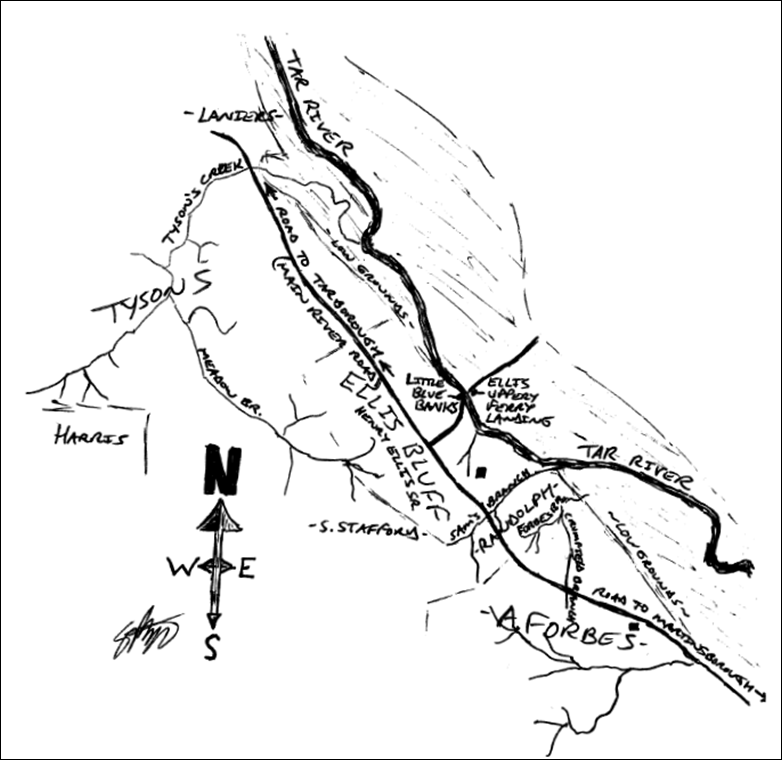
Map sketch of the Ellis Bluff vicinity, as the area was then known, circa 1776. The modern-day AgCarolina Farm Credit office sits just east of Crumfield Branch and south of the road (above the A. Forbes). The Ironwood neighborhood today sits on the old Randoph Land and over top of Forbes Branch. Rock Spring Center is located around the FF of “Ellis Bluff” on this map.
Ellis’ company was made up of local men in the immediate area. Generally, the Pitt County Militia seems to have been confined to the local area and to minimal duty during the war and Forbes likely didn't see extensive action. That being said, we do know that the majority of the Pitt County Regiment was deployed in May 1781 in an effort to stop Lt. Colonel Banastre Tarleton's legion and dragoons on their expedition through the North Carolina back country as Cornwallis attempted to move his army north. Tarleton may be a familiar name to those familiar with the story of General Francis Marion of South Carolina, whom Tarleton named “the Swamp Fox”. Tarleton is artistically portrayed as Colonel Tavington in the movie “The Patriot”.
The Pitt Militia intercepted Tarleton's force at Peacock's bridge on the Contentnea Creek just outside of what's now Stantonsburg. The 400 men of the Pitt Militia were outnumbered by the 800 in Tarleton's force but managed to inflict a few casualties before the dragoons crossed the bridge and broke the patriot militia lines. It's highly likely that the militia in the western part of Pitt, closest to Peacock's bridge, were the ones to deploy to that area- making it equally likely that Forbes was in attendance.
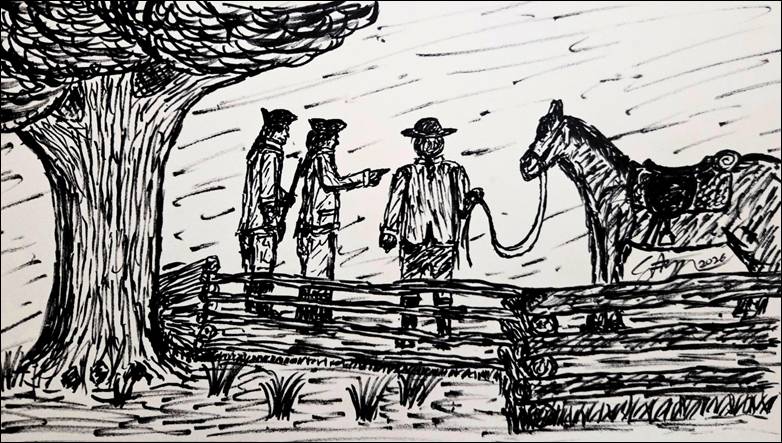
“The Officers of Captain Ellis' Company of Pitt County Militia circa 1776”, by Jonathan M. Riggs. This sketch recreates the sight of Captain Henry Ellis (center) and Lieutenants Arthur Forbes (L) and Samuel Stafford (R) discussing preparations or operations of their company of county militia under the shade of a large Spanish Oak known to be at Ellis Bluff plantation.
Arthur Forbes was also highly involved in the Pitt County Committee of Safety before and during the Revolution. Forbes served on the county “Select Committee of Secrecy and Intelligence” and was involved with smuggling war supplies into the state for the patriot cause.
Forbes must have been a highly respected man. He was elected in 1787 as one of Pitt's representatives to the state Constitutional Convention of 1788 where North Carolina was to decide whether or not to ratify the newly written US Constitution. Forbes and the majority of the Convention ultimately decided not to ratify but not reject the Constitution: instead insisting on a declaration of several specific rights and inclusion of a number of amendments in order to earn North Carolina's acceptance. Today we know the response to this assertion from the North Carolinians and others…we call it the Bill of Rights.
Though the name Arthur Forbes won't be found in the average history book, his life intersected with many formative events in early Pitt County. This local 18th century farmer didn't hesitate to answer the call to serve his community and his country and is worth remembering as we celebrate our nation's 250th birthday.